
Our Research

At , we develop methods, algorithms, and computational tools for complex engineering problems shaped by uncertainty. We take a broad view of both complexity and uncertainty: they may arise from limited or noisy data, high-dimensional inputs and outputs, missing or corrupted information, expensive or imperfect simulations, or uncertainty in physical models and design formulation itself. The specific challenge changes from problem to problem, but our underlying mathematical and computational ideas often do not. This common methodological core allows us to develop fundamental techniques that transfer across seemingly different applications in engineering and science.

Explore our research highlights below and visit the other tabs for related publications and data. We would love to hear from you so get in touch with the team if you have any questions or are interested in .

Data-Driven Design Under Uncertainty

Our focus is on making sound engineering decisions when data is limited, heterogeneous, expensive to obtain, or affected by uncertainty. Our work in this area spans representation learning, Bayesian optimization, multi-fidelity modeling and data fusion, curriculum learning, and robust- and reliability-based optimization. These developments support a broad range of applications involving material systems, thermal management, and advanced manufacturing.A central ingredient across many of these problems is emulation: building fast probabilistic surrogates that approximate expensive simulations or experiments while quantifying predictive uncertainty. So, we devote substantial effort to developing scalable and expressive emulators, with Gaussian processes (GPs) serving as a primary methodological foundation. When needed, we combine GPs with deep neural networks and modern computing architectures to learn rich representations and kernels for increasingly complex, high-dimensional problems.
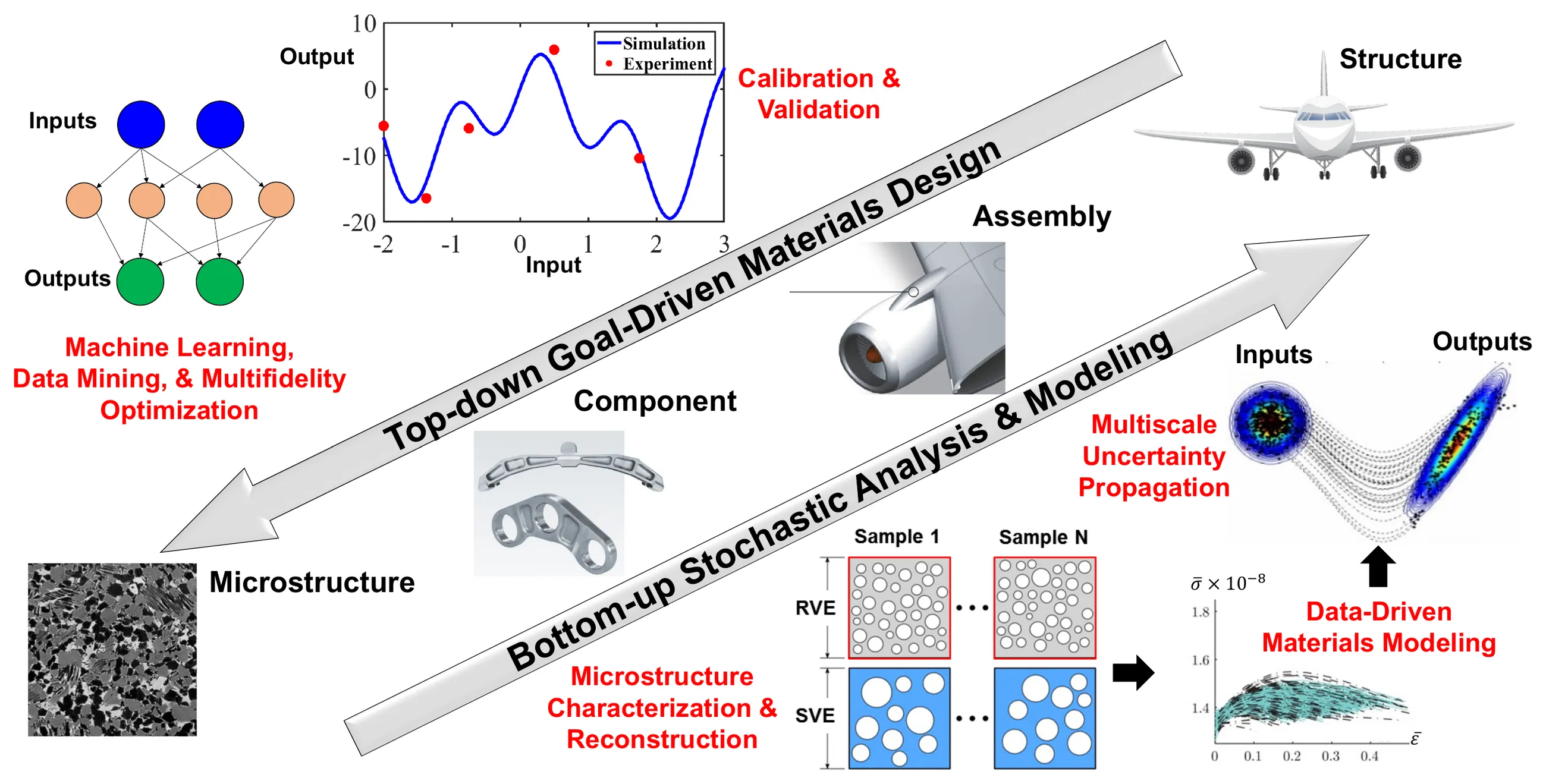
From microstructure to structure. We study multiscale design frameworks connecting bottom-up stochastic analysis and modeling with top-down, goal-driven materials design.
Diagram linking scales from microstructure to component, assembly and aircraft structure, with a bottom-up stochastic analysis and modeling arrow and a top-down goal-driven materials design arrow, annotated with machine learning, calibration and validation, multiscale uncertainty propagation, microstructure reconstruction, and data-driven materials modeling.
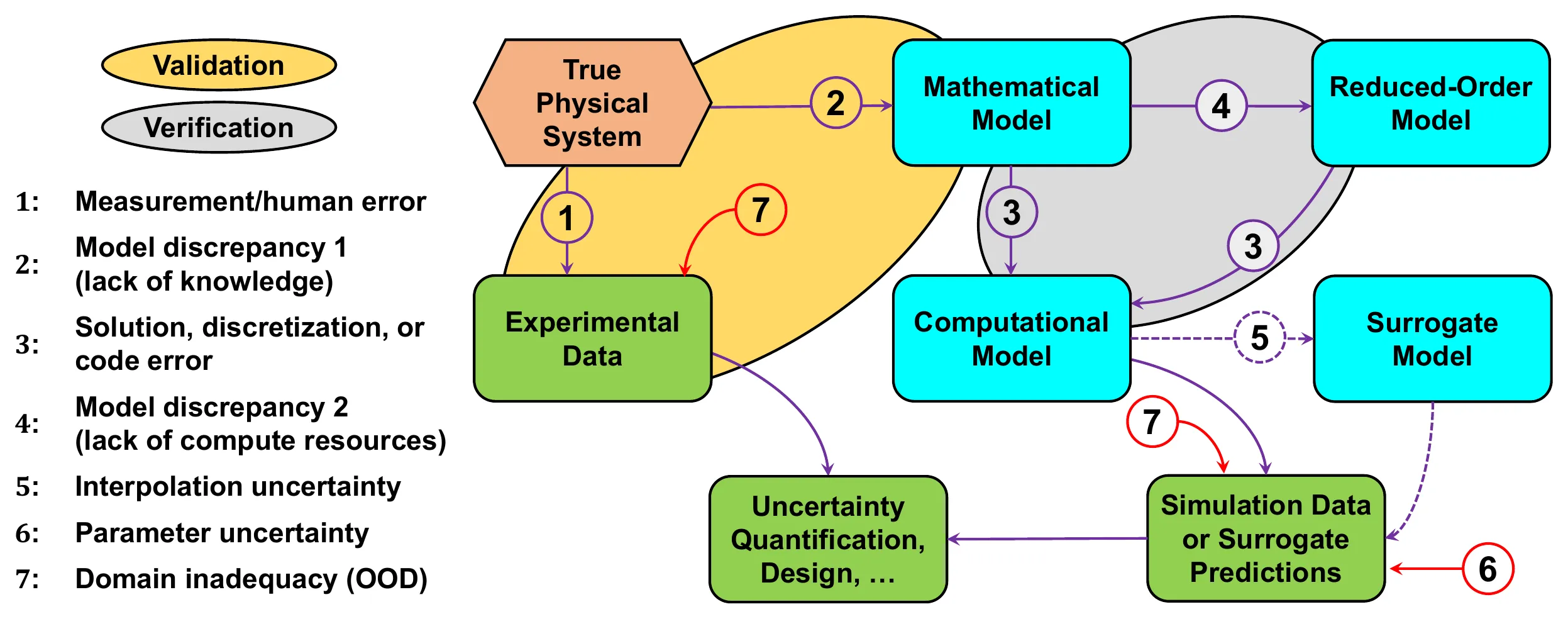
The many forms of uncertainty. Many engineering tools such as digital twins rely on uncertainty quantification (UQ). We study diverse sources of uncertainty and how they propagate across the modeling and simulation pipeline.
Flowchart from a true physical system through mathematical, computational, reduced-order and surrogate models to experimental and simulation data and uncertainty quantification, with seven numbered uncertainty sources: measurement error, two kinds of model discrepancy, solution error, interpolation uncertainty, parameter uncertainty, and domain inadequacy.
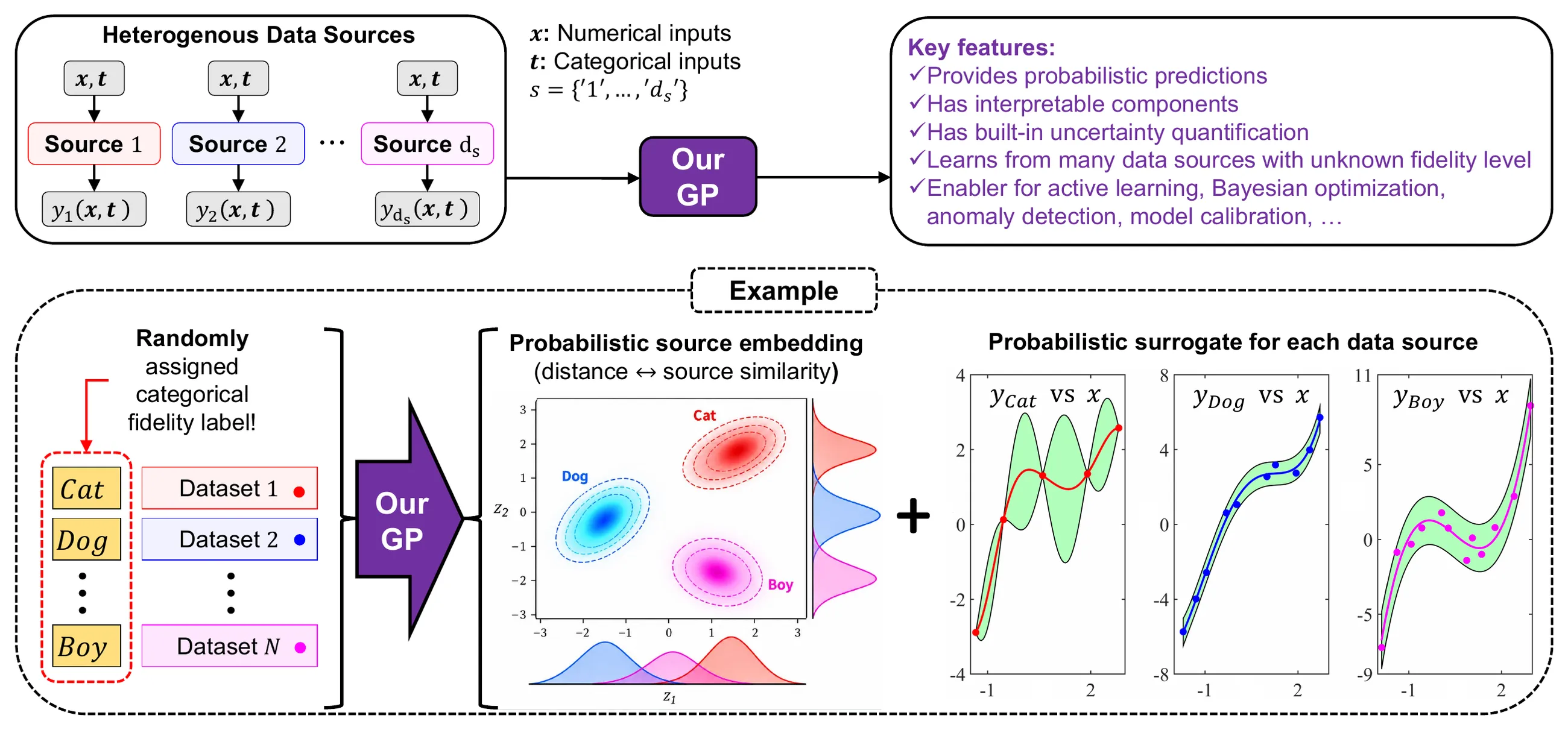
One model, many data sources. Our Gaussian process (GP) learns how heterogeneous sources relate, quantifies uncertainty, and turns them into a unified probabilistic surrogate for decision making, prediction, optimization, and calibration.
Several heterogeneous data sources feed one Gaussian process. In an example, datasets labelled Cat, Dog and Boy are mapped to a probabilistic source embedding where distance reflects source similarity, and the model gives a probabilistic surrogate with uncertainty bands for each source.

Machine Learning in Computational Mechanics

Recent advances in AI/ML and computing architectures are reshaping computational mechanics, from accelerating multiscale simulations to learning PDE solution operators and enabling differentiable modeling. At , we develop customized machine-learning methods for goal-oriented computational mechanics rather than treating learning as a stand-alone prediction task. Our emphasis is on models that can be embedded within downstream engineering workflows such as design, optimization, inverse analysis, and uncertainty quantification. This often requires combining mechanistic models with learned representations, developing efficient surrogates for expensive operators, and ensuring that the resulting models generalize well.
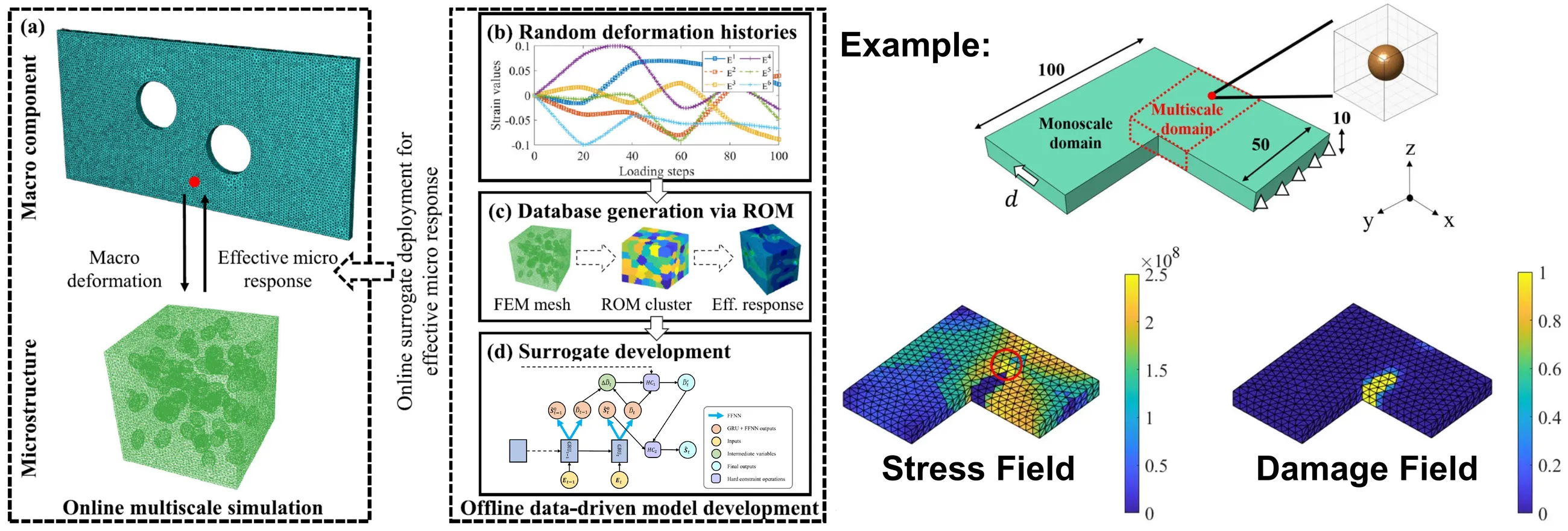
ML-accelerated multiscale simulations. We build mechanics-informed surrogates and the accompanying data-generation pipelines to learn constitutive laws that replace repeated, expensive fine-scale analyses in multiscale simulations.
Left: an online multiscale simulation in which a plate with two holes exchanges macro deformation and effective micro response with a porous microstructure. Middle: offline model development from random deformation histories, a reduced-order-model database (FEM mesh, ROM clusters, effective response) and a recurrent surrogate with hard constraints. Right: an example block with monoscale and multiscale domains and its predicted stress and damage fields.
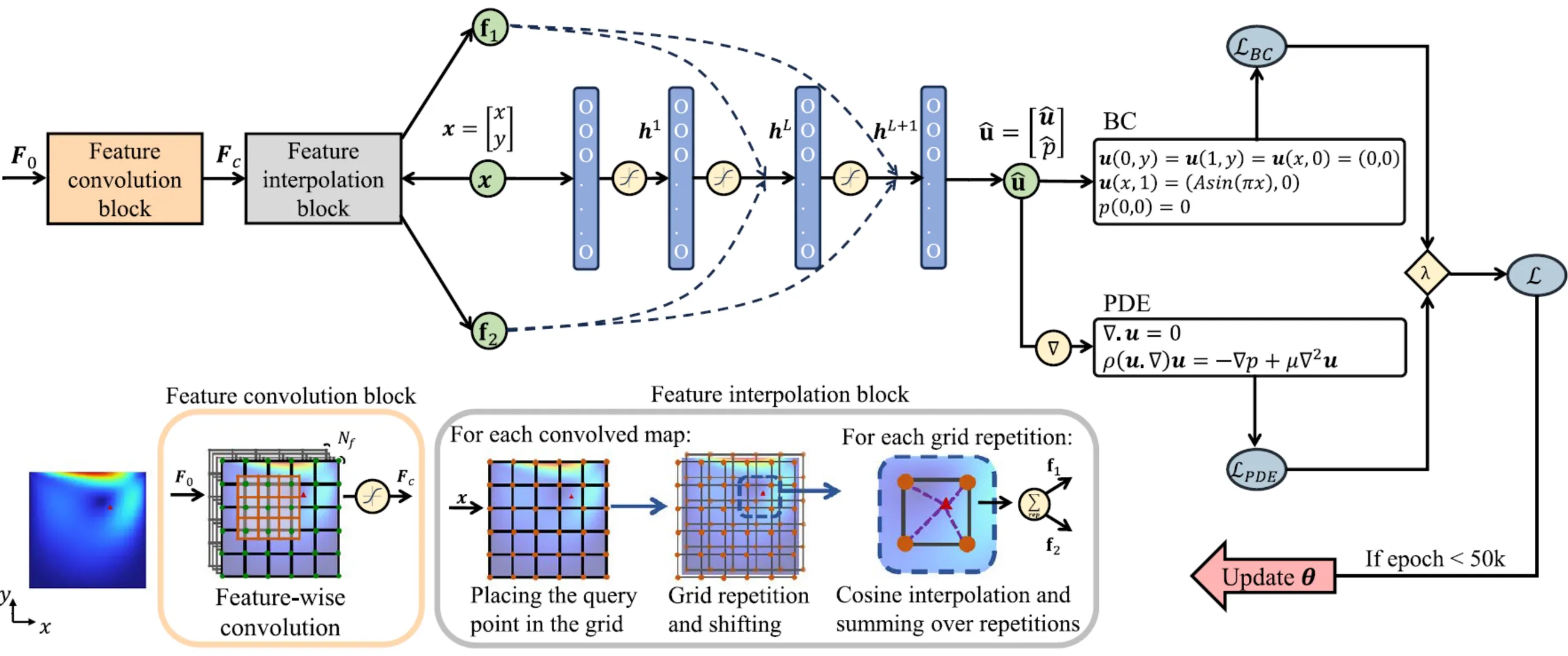
Neural architectures for physics-informed learning. We design specialized neural architectures that converge faster while capturing features critical to physical systems including sharp gradients and localized solution behavior.
Architecture: a feature convolution block and a feature interpolation block turn each query point into features f1 and f2 that feed the hidden layers of a network predicting velocity and pressure; boundary-condition and Navier-Stokes losses are weighted and minimized. Bottom: feature-wise convolution of grid feature maps, grid repetition and shifting, and cosine interpolation summed over repetitions.
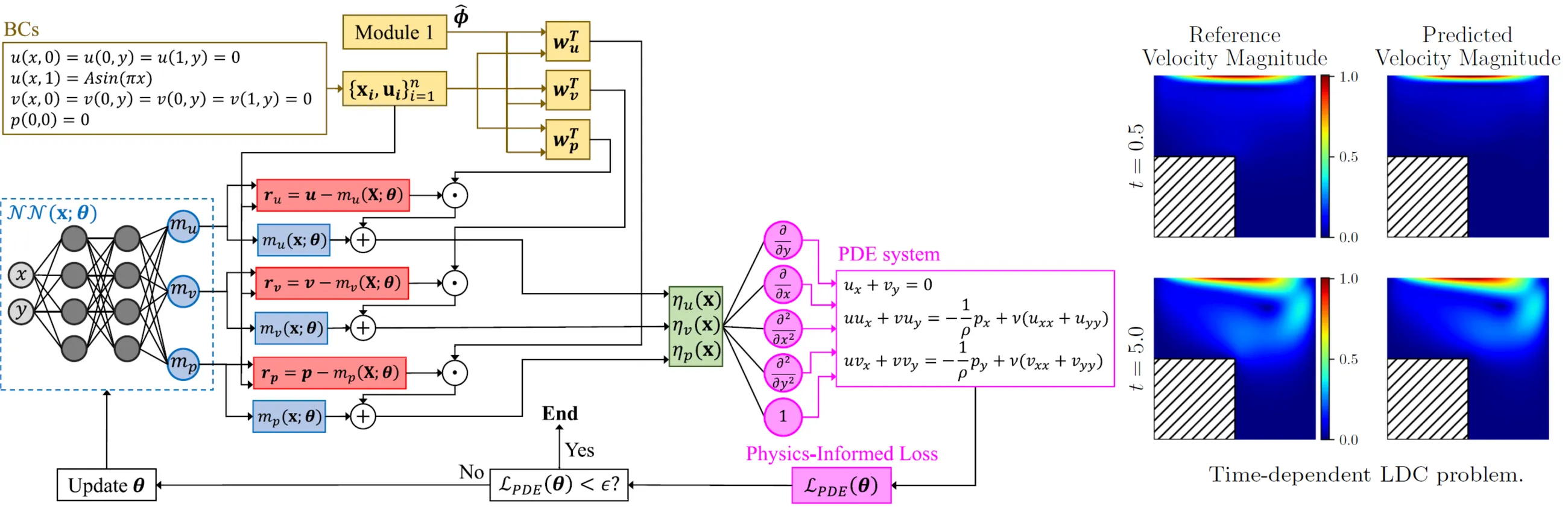
Kernels meet neural networks for PDEs. We combine Gaussian processes and deep neural networks to leverage their complementary strengths in solving nonlinear PDEs, improving accuracy and computational efficiency while simplifying the formulation of physics-informed losses.
Network outputs for velocity and pressure are corrected by kernel-weighted residuals computed at boundary points, then differentiated to evaluate the Navier-Stokes equations in a physics-informed loss. Right: reference and predicted velocity magnitude at t = 0.5 and t = 5.0 for a lid-driven cavity with an obstacle.
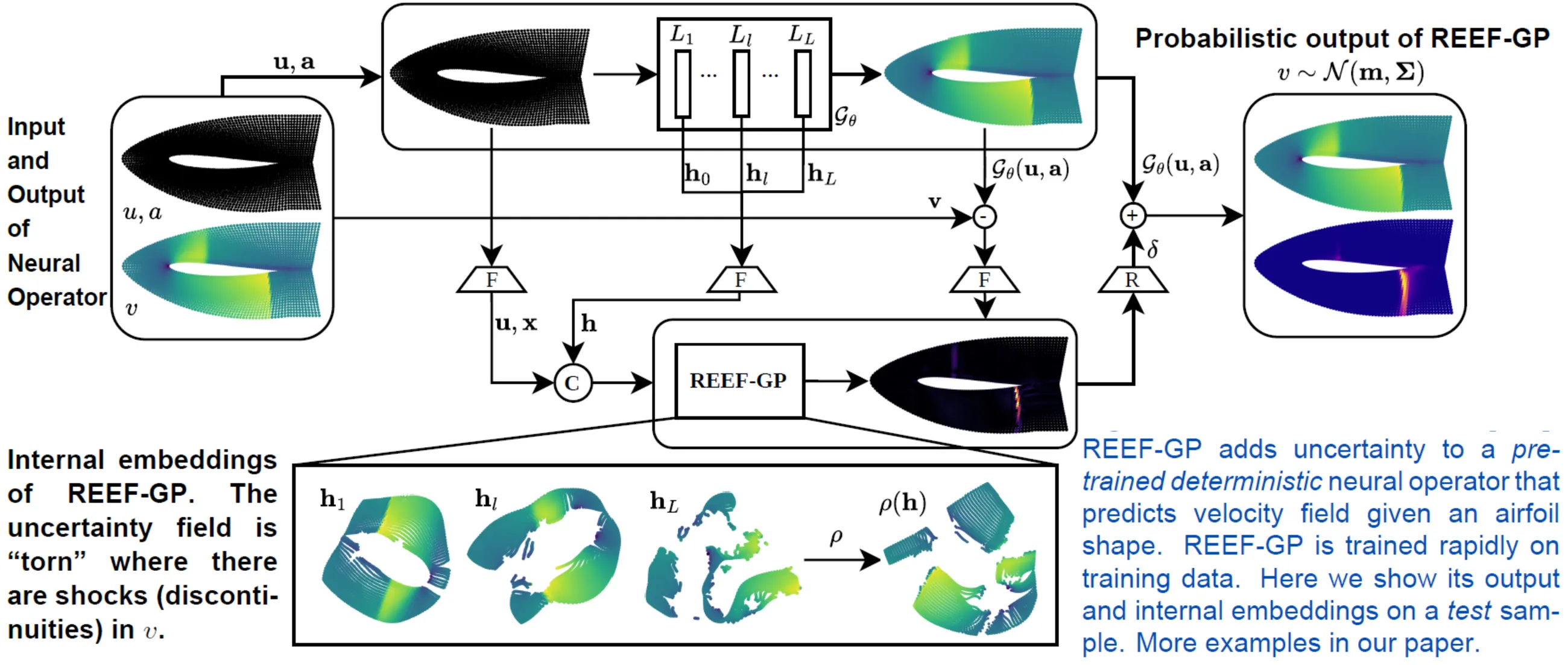
Probabilistic operator learning. We develop probabilistic surrogates of PDE solution operators or methods that can augment already-trained neural surrogates with predictive uncertainty maps.
A neural operator maps an airfoil mesh to its velocity field. Features from the operator's layers and its residuals feed REEF-GP, which returns a mean and covariance for the velocity. Insets show the predicted field, uncertainty concentrated at a shock, and REEF-GP's internal embeddings, which tear apart where the flow is discontinuous.

Topology Optimization on AI Architectures

The goal in topology optimization is to optimally distribute material within a design domain while satisfying governing physics and design constraints. At , we develop computational frameworks that combine topology optimization with modern AI architectures and ML tools to tackle large-scale, multiphysics, and multi-material design problems. We move beyond conventional discretization and optimization pipelines toward more flexible representations of geometry, physics, and design variables. These features enable us to address challenging settings involving uncertainty, disparate physical scales, and highly resolved design spaces, while also opening the door to super-resolution design and more efficient exploration of complex structural and multifunctional systems.
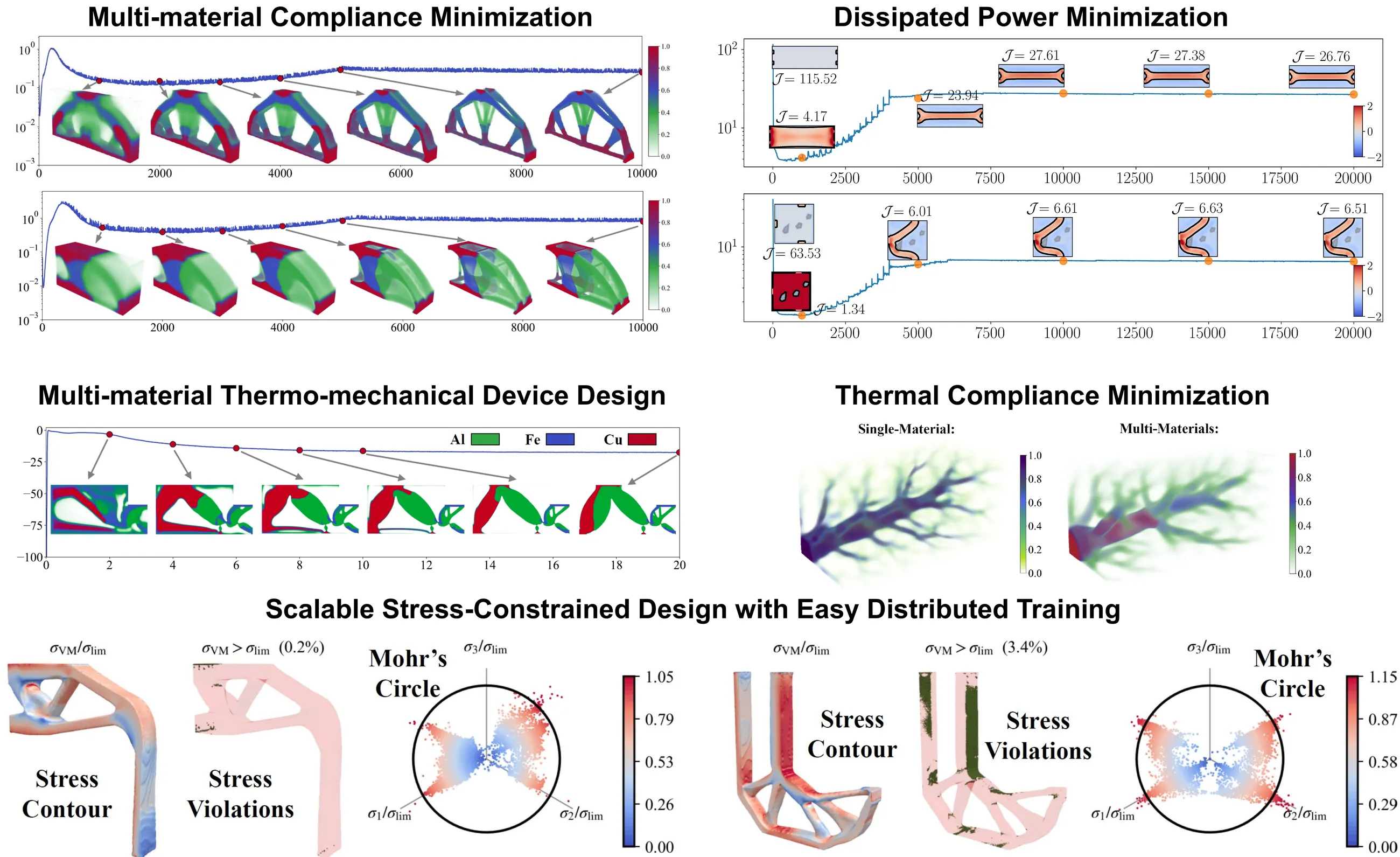
One framework for many design possibilities. We develop scalable single-loop topology optimization methods for designing super-resolution structures with multiple materials and coupled physics while accommodating global, local, and manufacturing constraints.
Five topology optimization examples. Multi-material compliance minimization of two 3D structures and dissipated power minimization for two flow problems, each with the design shown at several points along its convergence history. A multi-material thermo-mechanical device made of aluminum, iron and copper, and single- and multi-material thermal compliance designs that grow tree-like branches. Bottom: scalable stress-constrained design of two structures, with stress contours, stress violations (0.2% and 3.4%) and Mohr's circles.